
 Technology advances continue to reshape industries and businesses – and the accounting industry is no exception. So far, a lot of repetitive tasks are performed with the help of advanced hardware and software. Even for businesses that do not like change, many find themselves making adjustments due to a generation change in the workforce, marketing demands, regulations and client demand. In any case, technology offers strengths once a business adopts new solutions to the accounting processes.
The accounting industry has evolved so much that bookkeeping is no longer just about balancing books; professionals in this field are slowly transitioning into strategic business advisors.
Technological innovations offer inexpensive and efficient ways to run businesses and other aspects of life. Every now and then, there is news on emerging technologies.
Here are some tech trends that are expected to influence the accounting industry in the year 2020.
Cloud-Based Accounting
The internet has enabled the storage and processing of data from remote servers. Small- and medium-sized businesses can now leverage the power of the internet and access data and infrastructure without worrying about the cost of purchasing and maintaining hardware and software services on-site. The ease of accessing data anytime and anywhere helps businesses save valuable time. Such benefits will continue driving more businesses to adopting the use of cloud-based accounting systems.
Automation
Automating repetitive tasks has helped eliminate manual data entry while saving production hours at the same time. Since technology continues to advance, the accounting industry will see more tasks become automated. This trend can be observed in the growing number of accounting software available for both small and large businesses. Artificial intelligence will also contribute to automation in the industry. This is already evident with the increased development and adoption of robotic process automation.
Social Media
In the early 2000s, social media platforms were mainly used to communicate with family and friends. Today, social media is making an impact in digital marketing. Social media platforms will continue influencing how businesses communicate with their clients.
Apart from reaching out to more clients, accounting firms can also find talent to hire from social media platforms such as LinkedIn.
Big Data and Data Analytics
With advanced data collection and processing, it’s now possible to have access to insights and predictive analysis. Although analytics is not entirely new in accounting, the availability of data analytics tools makes it more powerful. This is important for business owners as it helps to improve decision making as well as understand the overall status of a company with the click of a button.
Cryptocurrency
This digital currency has revolutionized the financial industry with millions of coins present in the market today, including Bitcoin, Ripple and Ethereum among others. This digital currency has taken root so much that it is now accepted as a means of payment. Cryptocurrency has been enabled by blockchain technology.
Blockchain
For businesses, blockchain technology helps maintain a unique history of all interactions with various parties, which is indisputable. Widely known accounting companies like Ernst Young and Price Waterhouse already have people working in distributed ledger laboratories. The blockchain technology will not only lower the cost of reconciling and maintaining ledgers, but it will also provide accuracy of ownership and asset history.
Remote Working
Remote work settings are becoming common in most industries, and accounting leaders are also adapting this trend. With expectations of more advanced computerized accounting systems as well as cloud-based solutions, it will not be a surprise to have your accountant handling accounting tasks remotely.
In Conclusion
With technology largely affecting how businesses are run, it’s no longer enough for a business to stick to traditional accountancy practices.
As technology and accounting becomes more intertwined, it’s wise for businesses to stay ahead of the curve. The most important way to deal with it is to embrace the technology, learn about new technologies and most importantly, learn new skills. This will ensure that your business remains competitive as you are ready to meet customer demands for faster processes.
 Believe it or not, it’s 2020. You’re not just starting a new year, you’re entering a new decade. With this in mind, you might want to make some resolutions that focus on your finances. According to Psychology Today,
  A rising tide might lift all boats, but the same cannot be said for the economy.
 When it comes to 2020 and energy prices, the world’s energy market will face many known and unknown variables. How and what types of events that will ultimately play out are unknown but, according to industry and government experts, there are some variables that are projected to lead to lower global prices overall.
 When it comes to evaluating a business, especially one that is publicly traded, determining its return on equity (ROE) is one way to see how it’s performing.
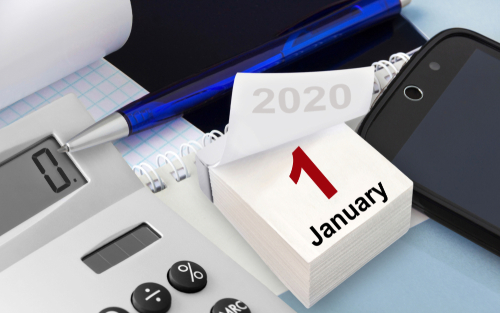 Beginning on Jan. 1, 2020, the Internal Revenue Service (IRS) has new annual inflation adjustments for tax rates, brackets, deductions and retirement contribution limits. Note, the amounts below do not impact the tax filing you make in 2020 for the tax year 2019. These amounts apply to your 2020 taxes that you will file in 2021.
 National POW/MIA Flag Act (S 693) – This bill amended title 36 of the United States Code to require that the POW/MIA flag be displayed on all days that the flag of the United States is displayed on certain federal properties. Previously, the POW/MIA flag was displayed only on Armed Forces Day, Memorial Day, Flag Day, Independence Day, National POW/MIA Recognition Day and Veterans Day. The legislation was introduced by Sen. Elizbeth Warren (D-MA) on March 7. It was passed in the Senate on May 2, passed in the House on Oct. 22 and signed into law by the president on Nov. 7.
 Eric Schmidt, former Google CEO, made a prediction in September 2018 that the internet will split in two – one part being led by China and the other by the United States. The reasoning behind this involves China’s active monitoring of all internet activities, as well as technological products and services from the country. Other reasons include a different leadership regime, controls and censorship.
 It may be hard to believe, but the end of the year is upon us. During this time, many of us might reflect on the year and tally up the good and the bad, the pros and the cons of the past 12 months. In a society that focuses on success and getting ahead, probably the most common thing to do is zero in on what you didn’t accomplish, or what went wrong. But science tells us that if you’re smart, you’ll look back with gratitude. And the best news is: it’s good for our health.